

In 2015, SPACETIDE held Japan’s first commercial space conference, at a time when the term “commercial space” did not even exist here. This conference sparked the rise of cutting-edge commercial space activities led by the private sector.
Ten years have passed since then, and in 2025, both the global and Japanese space industries have made significant progress, with many private companies thriving and massive investments pouring in. But, has the space industry fully unlocked its potential? For many people around the world, space is still a niche and distant field.
The theme of this 10th anniversary event was “The Next Decade: Unlocking Space for All Humanity.” During the conference, there were about 100 sessions and numerous side events, with approximately 1,800 people from more than 35 countries attending. This was the largest event to date.
In order for space to truly become a great industry, what should it look like a decade from now? A future where exploring space transforms every aspect of society and every industry. A future where many people can build careers in the space industry.
A future where everyone benefits from space technology and services in their daily lives. SPACETIDE aims to create that future with all of you at this 10th anniversary conference.
“The Next Decade: Unlocking Space for All Humanity” – let’s shape the new wave of the next decade together.
SPACETIDE2025 will co-host the Space2Earth Asia Summit 2025, which focuses on the practical applications of space technology in specific sectors such as agriculture, urban planning, and national security.
From Warpspace, Hirokazu Mori, who serves as both CSO/US CEO and CXO Advisor to the event organizer, the General Incorporated Association SPACETIDE, participated in the summit. This article reports on Mori’s insights gained during his visit to the event.
At this year’s SPACETIDE, attention was directed not only towards traditional “cooperation and coordination,” but also towards the importance of regional autonomy, with each country taking the initiative.
This is due to concerns about changes in US space policy following the change in administration. In particular, since the Trump administration, there has been a shift away from relying solely on global cooperation, and there is now a need for sustainable space development at the national or regional level.
Additionally, embassies from countries such as Singapore, New Zealand, the United Kingdom, and France held events during this period. Astronauts also visited Japan, highlighting SPACETIDE’s role as a hub connecting diplomacy and industry.
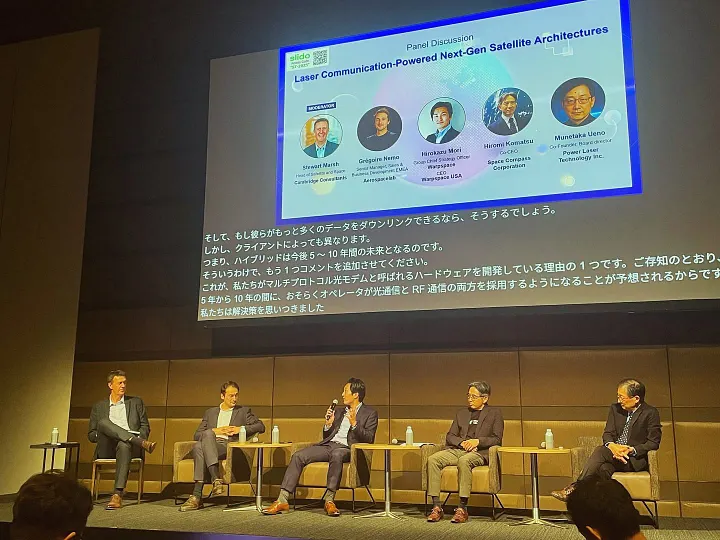
At this conference, a panel discussion was held on the theme of “Laser Communication-Powered Next-Gen Satellite Architectures,” and our Warpspace CSO/US CEO, Mori, took the stage.
The panelists included Stewart Marsh (Cambridge Consultants/Head of Satellite and Space), Grégoire Nemo (Aerospacelab/Senior Manager, Sales & Business Development EMEA), Yukihiro Mori (Warpspace/Group Chief Strategy Officer & CEO, Warpspace USA), Hiromi Komatsu (Space Compass Corporation/Co-CEO), and Munetaka Ueno (Power Laser Technology Inc./Co-Founder, Board Director).
It is worth noting that this technology, which facilitates high-capacity and high-speed data communication, is garnering interest in a variety of fields, including data relay for low-Earth orbit (LEO) satellites and high-precision communication during planetary exploration. In particular, the technical advantages of Japan and Europe in optical communication were discussed, as well as the necessity of international standardization in this area. It was suggested by speakers that government support is also essential to lead standardization, which may raise expectations for future policy support.
The emergence of new start-ups also attracted attention.
Power Laser, a start-up from Osaka University’s Laser Science Laboratory, is applying high-power laser technology to achieve innovative communications and energy transmission in space.
In addition, Aerospace Lab, a space start-up from Belgium, is also developing optical communication services, and the diversification of international players and the entry of new players into the market are also topics of interest. The application of laser technology in communications, observation, debris removal, and other areas is also expanding in the private sector.
Of particular note is the existence of LiDAR (Light Detection and Ranging), a laser ranging technology. LiDAR is a technology that uses laser light to measure distance and shape with high precision based on the time it takes for the light to reflect back. It is already being utilized in various fields such as topographic surveying, urban infrastructure management, and weather observation.