

As the global efforts for quantum development accelerate, the Department of Science, Technology and Innovation (DSTI) continues to fund programmes aimed at developing South Africa’s capacity in this technological frontier. The University of Pretoria (UP) officially launched its Quantum Science and Technology Hub (UPQuST), the sixth and newest node of the national South African Quantum Technology Initiative (SA QuTI). The initiative is aimed at building the local quantum science and technology ecosystem.
Held at the university’s Future Africa campus, the launch event brought together government representatives, researchers, students, industry partners and international collaborators to celebrate the establishment of a new hub dedicated to advancing research, technology development and postgraduate training in quantum technologies.
The node is led by Prof. Tjaart Kruger, who leads UP’s biophysics team, and it brings together interdisciplinary expertise from physics, chemistry, engineering and computer science. It is expected to strengthen South Africa’s quantum research capabilities while contributing to skills development, innovation and future economic opportunities. Its projects will span all three SA QuTI flagships (quantum computing, quantum metrology, sensing and imaging, and quantum communications), addressing real-world challenges in sectors such as agriculture, cybersecurity and fraud detection.
Since its inception in 2021, SA QuTI has established nodes at the University of KwaZulu-Natal, University of Zululand, University of the Witwatersrand, Stellenbosch University and Cape Peninsula University of Technology, with the Centre for High Performance Computing serving as the provider of the initiative’s quantum computing infrastructure.
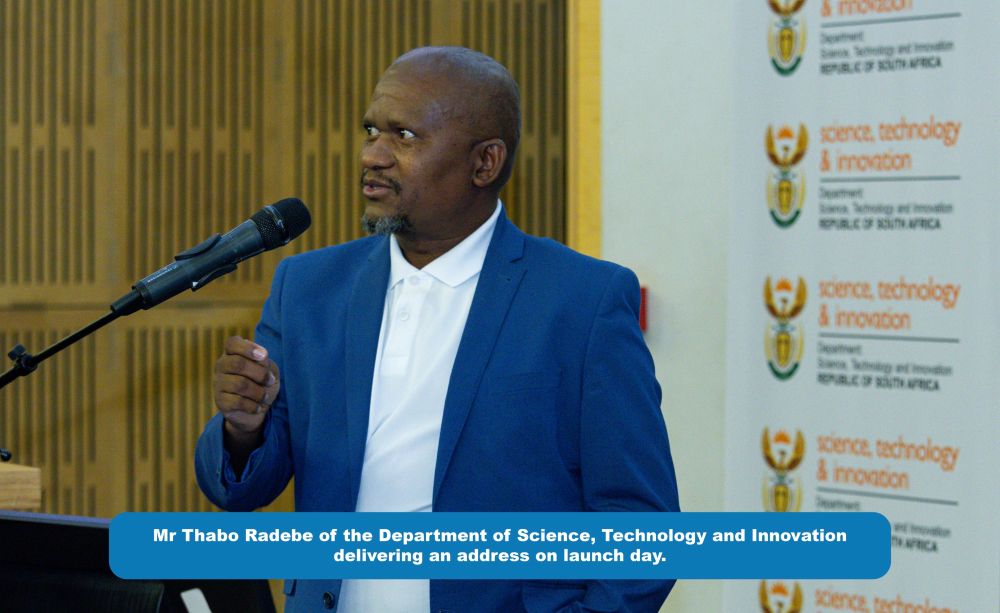
Speaking on behalf of the DSTI, Mr Thabo Radebe, Deputy Director: Basic Sciences, described the new hub as a strategic addition to South Africa’s national innovation system and a reflection of the collaborative approach needed to advance emerging technologies.
Mr Radebe said the launch aligns closely with the priorities of the Science, Technology and Innovation Decadal Plan, which is anchored on transformation, inclusivity and partnerships.
“We all understand transformation is important, but the work is far from done. We must keep broadening participation and strengthening institutions across the system,” he said.
He noted that, while South Africa’s science system continues to produce world-class research, greater efforts are needed to ensure that scientific achievements are visible and accessible to society. This includes strengthening science engagement initiatives, creating opportunities for young people and inspiring future generations to pursue careers in science and technology.
According to Mr Radebe, collaboration is essential for mobilising resources, aligning priorities and translating scientific excellence into large-scale societal impact.
Positioning UPQuST within the broader SA QuTI network, he said: “This hub is more than just a new node, it is a strategic addition to the national system. It reflects how partnerships between institutions, government and the broader innovation ecosystem can translate policy into practice.”
He said the Department intends to visit SA QuTI nodes so that government leadership can engage directly with researchers, innovators and students and witness quantum science and technology development in action.
Mr Radebe said the establishment of the sixth node is a clear sign of growth for the SA QuTI, but stressed that growth should not be seen as the end goal. He challenged the stakeholders to consider how the initiative could be taken to the next level.
He highlighted that the initiative must also strengthen its role in science engagement, particularly in schools and among young people, while ensuring that its work contributes to industrialisation and future economic opportunities.
Concluding his remarks, Mr Radebe issued a simple challenge: through partnerships, SA QuTI must continue to expand, mature and deliver impact at scale, because the real measure of science is not what gets published in journals, but how it improves people’s lives.
Prof. Sunil Maharaj, Vice-Principal for Research, Innovation, and Postgraduate Education at UP, also gave an address at the event. He said that the launch is a milestone in the country’s growing quantum ecosystem and reflects our collective commitment to advancing scientific discovery, developing talent, and positioning our country to participate meaningfully in one of the most transformative technological frontiers of our time.
“Quantum science and technology challenge us to rethink what is possible. By harnessing the extraordinary behaviour of matter and light at the smallest scales, quantum technologies promise breakthroughs that were once confined to theory,” he said.
These include dramatically increased computing power, highly secure communication systems and unprecedented precision in sensing and measurement.
Prof. Maharaj expressed deep gratitude to the DSTI for its investment and confidence in this initiative through five years of dedicated support. He also acknowledged and thanked all the partners who contributed to turning this vision into a reality.
“At the University of Pretoria, we believe that addressing the complex challenges of the future requires not only excellence within individual disciplines, but also meaningful collaboration across them,” expressed Prof. Maharaj.
Ms Jodie Robbertse, SA QuTI Project Manager, explained that the initiative aims to build critical mass and capacity in quantum science and technology by bringing together researchers and institutions to pursue nationally relevant goals.
“The initiative’s activities span the country and include flagship research projects, smaller developmental projects, and training, advocacy and outreach programmes,” she said.
Ms Robbertse said that UP’s involvement in SA QuTI began through a smaller project and has since grown into a fully-fledged node within the national network. She said the addition strengthens the initiative’s national capacity, growth and impact.
A distinguishing feature of SA QuTI, she said, is its collaborative approach. Researchers work across institutions, expertise is shared rather than siloed, and the initiative is increasingly engaging industry partners to support the growth of South Africa’s quantum ecosystem. Progress in the field, she noted, depends on collective effort.
Ms Robbertse further emphasised that a key priority of the initiative is to develop the skills, expertise and leadership needed to sustain the field into the future. Through programmes such as the Emerging Leaders Programme, it is building a pipeline of talent by supporting students and early-career researchers while nurturing the next generation of quantum leaders.
Echoing the importance of collaboration, Mr Thapelo Tladi, Programme Lead at the South African Centre for Industry and Technology (SACIT), said the establishment of SA QuTI in 2021 was particularly timely as it coincided with the launch of the Quantum Economy Network by the World Economic Forum (WEF). The initiative emerged from a growing recognition among governments, businesses and research institutions that quantum technologies will underpin the next generation of economic growth, industrial competitiveness and scientific discovery.
Globally, governments, universities, and industries are investing heavily in this field because of its potential to transform sectors as diverse as healthcare, agriculture, finance, energy, advanced manufacturing, and national security. South Africa’s early and strategic investments since 2021 have already positioned the country as a frontrunner in what is becoming an increasingly competitive global landscape.
Mr Tladi noted that the nations developing quantum capabilities today will help shape the industries of tomorrow. For South Africa, this presents both a challenge and an opportunity. The challenge lies in competing in a highly sophisticated, technology-driven global environment, while the opportunity is that the country is starting from a position of strength.
“We have a strong scientific foundation, internationally respected researchers and a national platform that helps coordinate efforts across the country. If we are serious about building a quantum economy in South Africa, collaboration must be at the heart of our approach,” he said.
He added that success in the quantum field is about producing world-class research and ensuring that it is connected to real-world needs and opportunities. In many ways, it embodies the spirit of cooperation required for success.
Looking ahead, Mr Tladi said South Africa needs a coordinated mechanism that connects researchers, industry and government, while also linking the country to global initiatives such as those supported by the WEF. In this context, its role must evolve beyond research to help address industry challenges and create opportunities for academia and industry to explore practical applications of emerging technologies together.
He emphasised that the government’s role extends beyond funding. By creating an enabling environment for innovation, the government helps ecosystems such as SA QuTI to thrive. The DSTI’s support has been instrumental in establishing the initiative and building momentum for future growth.
However, much of the impact of the initiative will ultimately be realised in industry. It is through adoption and commercialisation that innovation moves from the laboratory into the marketplace and society. As one of the WEF’s global fourth industrial revolution centres, SACIT aims to facilitate this process by bringing partners together through both the WEF network and local collaborations to support the UPQuST node and the broader SA QuTI network.
He described the launch as the beginning of a strong and productive relationship among stakeholders across South Africa’s quantum ecosystem.
“The time has now come to move from preparation to action. If South Africa is to succeed, our ambition should not simply be to participate in the global quantum economy. Our ambition should be to help shape it. Let us be bold. Let us be ambitious. While there are many areas in which South Africa is working to catch up with global competitors, quantum technologies may well be one area where we have an opportunity to lead,” concluded Mr Tladi.