


The European Space Agency is broadcasting the very first images from its Euclid cosmology satellite on July 31, 2023. Less than a month after its launch, the machine arrived at its destination.
These are still only test images, but they show that both Euclid instruments work ! Thirty days after its launch, the latest of the astrophysics satellites of the European Space Agency (ESA) reached its final orbit at 1.5 million kilometers from the Earth and was able to take its first shots.
Produced in the visible as well as in the near infrared, they give hope of excellent performance for its ambitious mission: to produce the largest and most precise 3D map of the Universe ever created, and to measure the shape, position and distance from galaxies up to 10 billion light years.
Half a billion pixels to decipher the universe
The first images from VIS, a camera operating between 550 and 900 nm wavelength in the visible, show a parcel of the immense territory that Euclid will be responsible for mapping during its six-year mission (a third of the sky in total ).
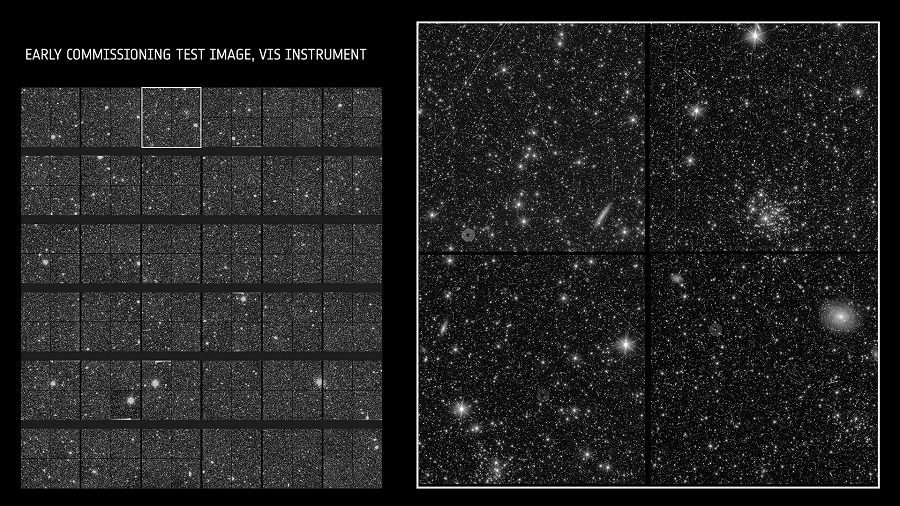
Thanks to the 576 million pixels accumulated by its 36 CCD detectors, the instrument will be able to measure the shape of several billion galaxies. Some are already visible on these raw images, where many artifacts still appear (in particular the trails of cosmic rays passing through the detector).
The Universe at wide angle
As the image below suggests, NISP (Near-Infrared Spectrometer and Photometer) also works perfectly. In just 100 seconds, five times less time than expected for the scientific phase, it easily reveals galaxies and star clusters.
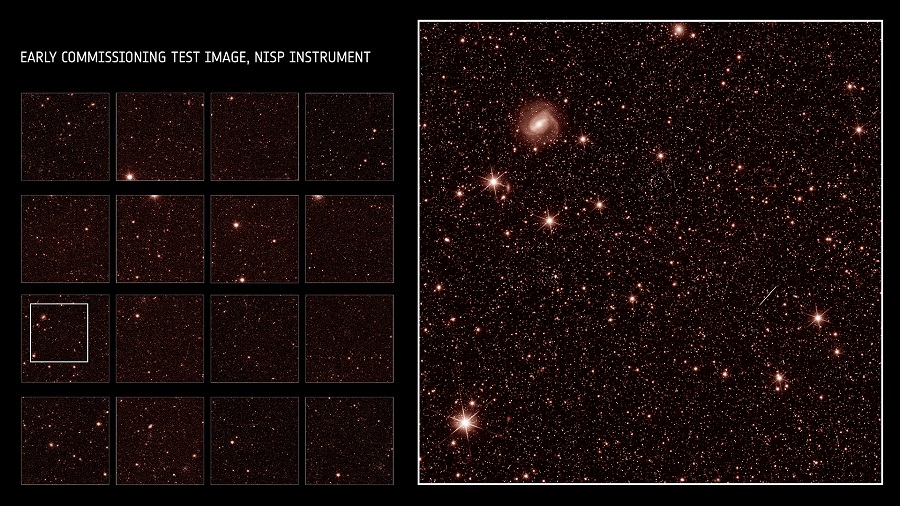
Euclid’s near-infrared spectrometer and photometer (900-2000 nm) has a field of view of 0.55 square degrees. The largest for an infrared instrument in space. NISP is essential in the mission since it will not only be responsible for producing the image of distant galaxies, but also for precisely measuring their distance. And it is a precise vision of the Universe in 3D that astronomers wish to obtain thanks to Euclid.
Unravel the mysteries of dark matter and dark energy
Euclid is a 1.2 m diameter space telescope entirely dedicated to studying the expansion of the Universe and its fundamental ingredients: dark matter and dark energy. To find out all about its mission and its importance in cosmology, read the 20-page dossier of our newsstand issue, Ciel & Espace n°590, “The day the universe changed. »