

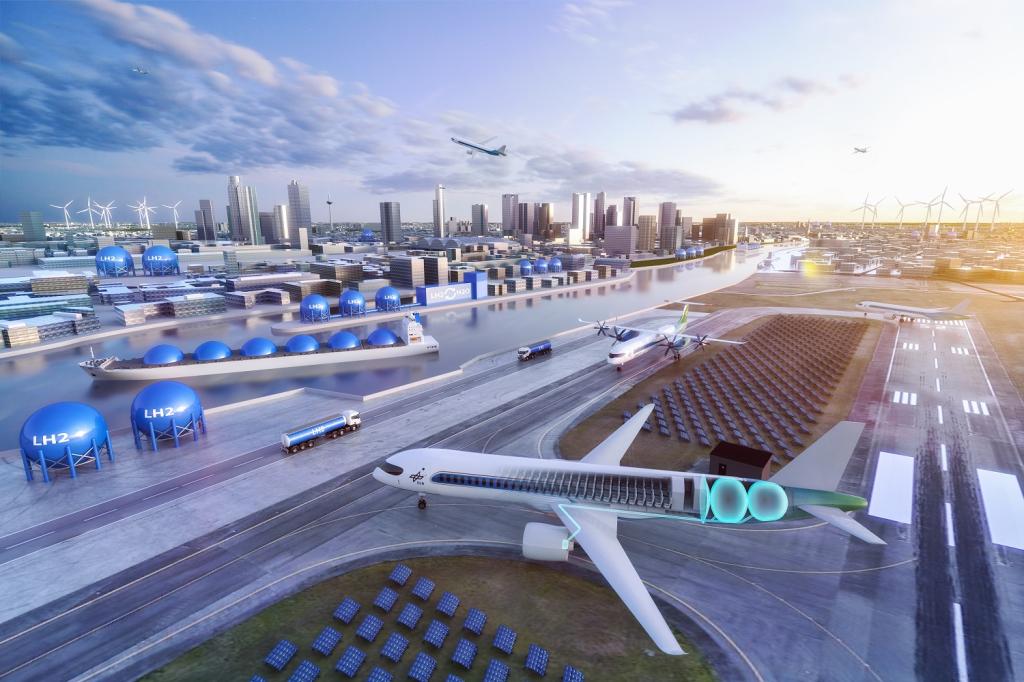
How would mobility in the sky have to be designed to drastically reduce emissions caused by air traffic? The whole world speaks of hydrogen as a savior. In order to be able to fly with it, not only completely new drives are necessary: Hydrogen has to be generated and transported to the airport. How can these changes be implemented while still flying economically? The German Aerospace Center (DLR) is investigating these questions. The climate researcher Dr. Katrin Dahlmann, the aviation propulsion engineer Jannik Häßy and Dr. Veatriki Papantoni, who conducts research in the field of renewable energies, talk about how low-emission aviation can be achieved.
With the Climate Protection Act, the German federal government is aiming for greenhouse gas neutrality by 2045. What role does air traffic play in this?
Häßy: In 2019, at the pre-pandemic level, this caused around three percent of CO 2 emissions worldwide. As the vaccination rate increases, the desire for business and leisure trips will likely return. It can also be assumed that the global demand for air travel will continue to grow over the next few decades.
Dahlmann: In aviation in particular , other effects besides CO 2 also influence the climate. Aviation currently contributes five percent to the man-made greenhouse effect. There is an urgent need for action to reduce air traffic emissions and their impact on the climate.
Do you necessarily have to travel less if you want to protect the climate?
Häßy: In my opinion, the world is too diverse and beautiful to do without long-distance travel entirely. Intercultural exchange is important for a peaceful world. But of course we should ask ourselves every time we travel by plane whether it is necessary. Radically innovative aircraft concepts could have a significantly lower impact on the climate. However, aerospace engines have long development times.
Dahlmann: In the short term, changes in flight control and route planning could reduce the impact on the climate. If you fly in a deeper layer of the atmosphere, the climate-warming effects could be reduced by up to 42 percent. One problem, however, is that the aircraft use more fuel and fly slower due to the higher friction. Another option is to avoid areas where contrails are increasingly forming. Long distances in formation flight could also save greenhouse gases and reduce the formation of contrails. This would only require solutions in the area of flight control and air traffic management.

And which technical innovations could be considered to protect the climate?
Häßy: Today’s aviation gas turbines can become more efficient and emit fewer greenhouse gases with larger fans, new materials such as ceramics or advanced cooling technology. In addition, sustainable fuels, so-called Sustainable Aviation Fuels (SAFs), can be used. They lead to a closed carbon cycle, since they only contain the CO 2 during combustion release that was bound during fuel production. The use of hydrogen as a fuel makes an aviation engine carbon-free. Hydrogen is either burned in an aircraft gas turbine or converted electrochemically in a fuel cell. However, many innovations are necessary for this. Other tanks are an example, because liquid hydrogen has a larger volume than kerosene and must be stored at extremely low temperatures.
Dahlmann: Redesigned aircraft wings can also reduce fuel consumption. That would make a deeper flight much more cost-efficient. It will still be a bit more expensive. Political requirements, for example trading in emissions certificates, could make this easier to implement in practice and create incentives for airlines.
Is the corona pandemic a good time to drive innovation?
Dahlmann: In April 2020, due to the pandemic, there was 90 percent less passenger air traffic, i.e. less CO 2 , ozone and contrails, i.e. less impact on the climate in the short term. To protect our climate, we need long-term effects. I think the Fridaysfor Future campaign and the storms in summer 2021 made society aware of the problem. Even if the pandemic has hit the entire aviation industry hard, now is an important time to rethink.
Ms. Dahlmann, in connection with climate change, CO 2 is often the cause. At the beginning you also mentioned other influences. What are the effects?
Dahlmann: In addition to CO 2 , nitrogen oxides (NO x ) are also produced when conventional fuel is burned. These react with oxygen and increase ozone production. In the stratosphere, the ozone layer protects the living things on earth from too much solar radiation. In deeper layers of the atmosphere, more precisely the upper troposphere, in which air traffic takes place today, ozone has a global warming effect. In addition, the effect of contrails should not be underestimated. They are nothing more than clouds and keep the warmth in the atmosphere.

Mr. Häßy, do you already have plans for drive systems that could also solve these problems?
Häßy: A gas turbine that is powered exclusively by hydrogen does not generate CO 2 , but mainly water vapor. In addition, fewer nitrogen oxides could be produced than when conventional or synthetic fuels are burned. In addition, there are no soot particles and therefore fewer contrails. If hydrogen is converted into fuel cells, NO x emissions could even be completely eliminated.
Isn’t water vapor a powerful greenhouse gas?
Dahlmann: That’s right. However, it only stays for a short time in the upper troposphere. It only rises at greater heights and thus has a greater impact on the climate. Direct hydrogen combustion generates more water vapor, but studies show that this accounts for just ten percent of the climate impact. We are currently investigating the influence with our AirClim climate model.
Today’s airplanes all work in a similar way with well-tried aerospace gas turbines. How can you use new technologies in such a way that ticket prices remain affordable?
Häßy: At the moment, it is not entirely clear which technology has proven itself where. We are currently assuming that fuel cells are more suitable for powering small, short-haul aircraft. For the medium to long haul, the combustion of hydrogen in gas turbines could prevail. The short-term alternative would be SAFs. Fuel currently accounts for around 20 to 30 percent of the operating costs of a commercial aircraft. SAFs will initially increase these costs. However, DLR is working on ways to reduce this again. This could be done, for example, via a different fleet deployment plan. Airlines could cover shorter distances with smaller, more efficient and fully loaded aircraft. The ticket prices will certainly increase.
And doesn’t CO 2 have different effects up in the atmosphere when burning sustainable aviation fuels (SAFs) than on the ground, such as ozone?
Dahlmann: No, CO 2 is distributed evenly in the atmosphere due to its very long lifespan.
If the aircraft change like this, doesn’t the infrastructure, for example airports, have to adapt too?
Papantoni: The more aircraft that run on hydrogen, the greater the amount required. Trucks can transport smaller amounts of hydrogen to the airport. If the demand increases, the expansion of a corresponding supply network becomes necessary. In regions with a high potential for renewable energies, on-site electrolysis would pay off.

How much hydrogen is needed to fill up large fleets?
Häßy: The energy content of hydrogen per kilogram of fuel is around three times that of kerosene. Around ten million tons of kerosene are required in Germany every year. Accordingly, a third of that would be needed in hydrogen. But the provision in Germany alone is not enough, the destination airports would also have to have a hydrogen infrastructure.
How can enough hydrogen be produced sustainably and economically for global air traffic?
Papantoni: Not only aviation needs hydrogen, but also industries that can hardly be decarbonised otherwise, such as the steel and chemical industries or shipping. For this, the production of renewable energies would have to be expanded. The energy system should become more efficient. Regions with little wind or sun will, however, have to rely on imports. Higher prices for CO 2 , for example through EU emissions trading, will make hydrogen more attractive as an alternative energy source.
What are the environmental effects of producing hydrogen by electrolysis? Isn’t it inefficient if SAFs and hydrogen first have to be generated at great expense?
Papantoni: The climate impact is only part of the environmental impact. The production of hydrogen requires electricity, water and the corresponding systems. For one kilogram you need up to 18 liters of particularly pure water. So when building a hydrogen economy, we have to make sure that there is enough water available. We also examine the environmental impacts that arise when the raw materials are extracted for the plants. For applications that are easy to electrify, such as cars, SAFs and hydrogen are likely to be less relevant. For long-haul flights or maritime applications, these energy sources are an eco-efficient alternative. There are also synergies in the production of SAFs and hydrogen. The amount of renewable energies to be generated can fluctuate depending on the season. It is possible,
As a scientist, how do you manage to foresee all of this so precisely?
Häßy: Airplanes are very complex systems because there are many interdependencies between the individual components. At DLR there are specialists for the respective systems and disciplines. The difficulty lies in bundling all knowledge and making it usable as a unit. In the EXACT project , we are developing software that combines the capabilities of the various DLR institutes. In this way, we evaluate a whole range of scenarios with different drive concepts and aircraft types, including their impact on the climate. Findings from the project could help the industry to decide for or against a technology.
Dahlmann: With our AirClim model, we determine the change in global near-surface temperature due to emissions and contrails. In conjunction with other DLR software tools, we are evaluating possible solutions to how the impact of future air traffic on climate change can be reduced despite increasing traffic figures.
Papantoni: In addition to the climate impact caused by emissions, in EXACT we also examine the environmental impact that arises when the aircraft are operated or during their production. To do this, we create a so-called life cycle assessment that analyzes energy and material flows over the entire life cycle. This enables us to estimate the expected impacts on the ecosystem or human health.