

Some of the plans for the new year were presented at the annual press conference of ESA’s Director General last week.
ESA and industry in Europe are building the service module for NASA’s new spacecraft Orion , which will transport astronauts, experiments and supplies to the moon.
Two of the modules for Gateway, the new international space station that will orbit the moon, will also be European. Thus, three of ESA’s astronauts will go to the Gateway when it is ready for use.
New astronaut outlet this year
The preparation and training to be able to perform manned space travel to the Gateway, the moon’s surface and even further out into space has long since begun.
Two of ESA’s astronauts are going to the International Space Station in orbit this year. The first is Thomas Pesquest, ESA’s French astronaut, who will be launched in the spring.

In the last quarter of 2021, Matthias Maurer will be launched. He is a German astronaut for ESA and this will be his first trip in space. In 2019, he was on a moon geology course in Lofoten .
In addition, ESA will begin the selection of a new group of astronauts in 2021. Citizens of all ESA member countries can apply here. More information about the new astronaut extraction will come on February 16, 2021.
Launchers for a growing market
ESA develops its own launch vehicles for large and small payloads. The Vega launcher is used for small payloads, and in 2021 the new Vega-C will have its first launch.
The development of Ariane 6, the new European launch vehicle for large payloads, will continue in 2021. Ariane 5 is today considered the world’s most reliable launch system and is commercially available.

Illustration: ESA
“With the new launchers, we want to maintain our position in the highly competitive launch market,” said outgoing CEO Wörner at the press conference.
Closer cooperation with the EU
In 2021, ESA gets a new CEO, Austrian Josef Aschbacher. Today, he is ESA’s director of Earth observation and research on Earth’s major systems. He takes over for Jan Wörner during the first half of the year.
Not all ESA countries are members of the EU and vice versa, but ESA works closely with the EU, especially in the Copernicus environmental monitoring program and the Galileo and EGNOS navigation programs.

Photo: Police / Ned Dawson.
The new Director General wants to continue and strengthen this cooperation, and will prepare a vision for space up to 2025 that is common to ESA and the EU.
Quantum communication and digital earth
Six new Copernicus satellites are under development and the second generation of Galileo satellites is planned.
Several new research satellites in the Earth Explorer program are also on the way. More candidates will be selected in 2021.
ESA develops both spacecraft and launch vehicles, and is both a partner and customer for the industry in Europe. The new Director General wants ESA to continue commercialization and help create a new economy in space .
The incubation centers that ESA has throughout Europe, including at Kjeller outside Oslo, support innovation and development of new products and services based on space technology or data from space. ESA’s collaborative network with leading universities, among them NTNU , also contributes to this.

Photo: EUMETSAT / DLR
The development of new communication technology is just one of the innovations that ESA will support in 2021. It includes so-called quantum communication , which will provide more secure encryption of digital data.
– ESA wants to have the first services in quantum communication ready already in 2024, Wörner said.
The enormous amount of data from the environmental program Copernicus , together with artificial intelligence, ESA wants to use to, among other things, form a holistic model of the earth and all its processes, a so-called digital twin.
ESA’s development important for Norway
– ESA’s collaboration with NASA related to the further exploration of the moon is very exciting. Here, both European and Norwegian industry are in a position to make deliveries. We have ongoing deliveries from Norway for the new lunar missions, as well as new possible deliveries that the Norwegian Space Center is working to get in place, says Christian Hauglie-Hanssen, CEO of the Norwegian Space Center.
He sees it as very positive that the Artemis program is international and that ESA’s service module for Orion is closely integrated into the new lunar program.
– It means the continuation of good international cooperation, which manned spaceflight has meant for decades through the International Space Station, and it is also pragmatic to share the costs of travel that no country can do alone. This applies not least to the long-term ambitions for Mars, says Hauglie-Hanssen.
With the new astronaut outlet, ESA has the opportunity to expand its capacity in manned spaceflight, and get astronauts both to the new space station Gateway in orbit around the moon, and down to the moon’s surface.

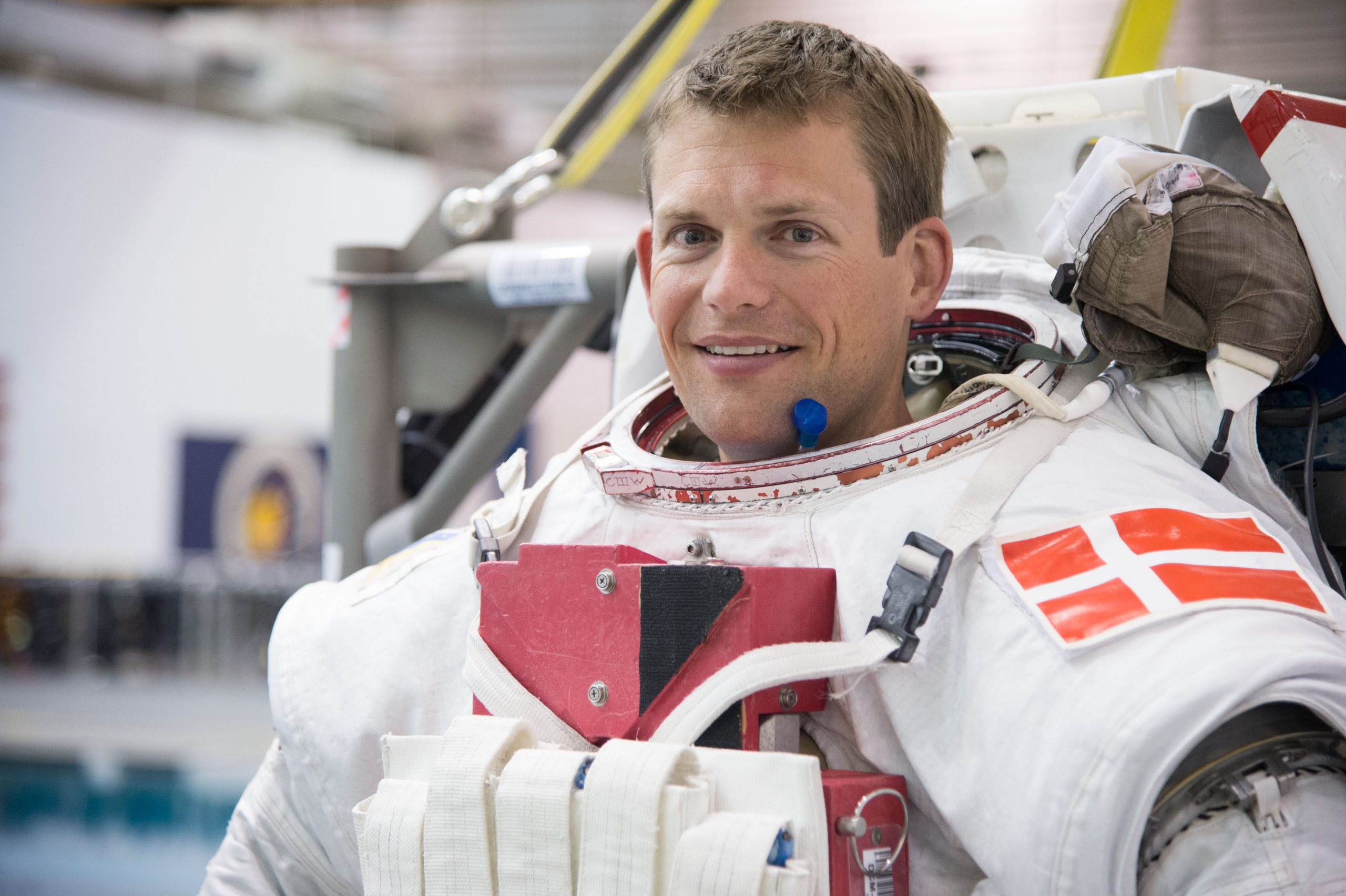
Here he trains for assignments outside the space station.
Photo: NASA / ESA-J.Blair
The Norwegian Space Center will support ESA in this process and help them receive applications from as many good and relevant candidates as possible. When and if good candidates come from Norway, we will also support them in the selection process, says Hauglie-Hanssen.
He considers strengthening ESA’s cooperation with the EU to be very important, and that it will be one of the major tasks for the new Director General.
– It will also be important for Norway’s position, because ESA is our channel towards the EU’s space programs. Together with the EEA agreement, it forms the core of Norway’s cooperation with the EU, says Hauglie-Hanssen.