

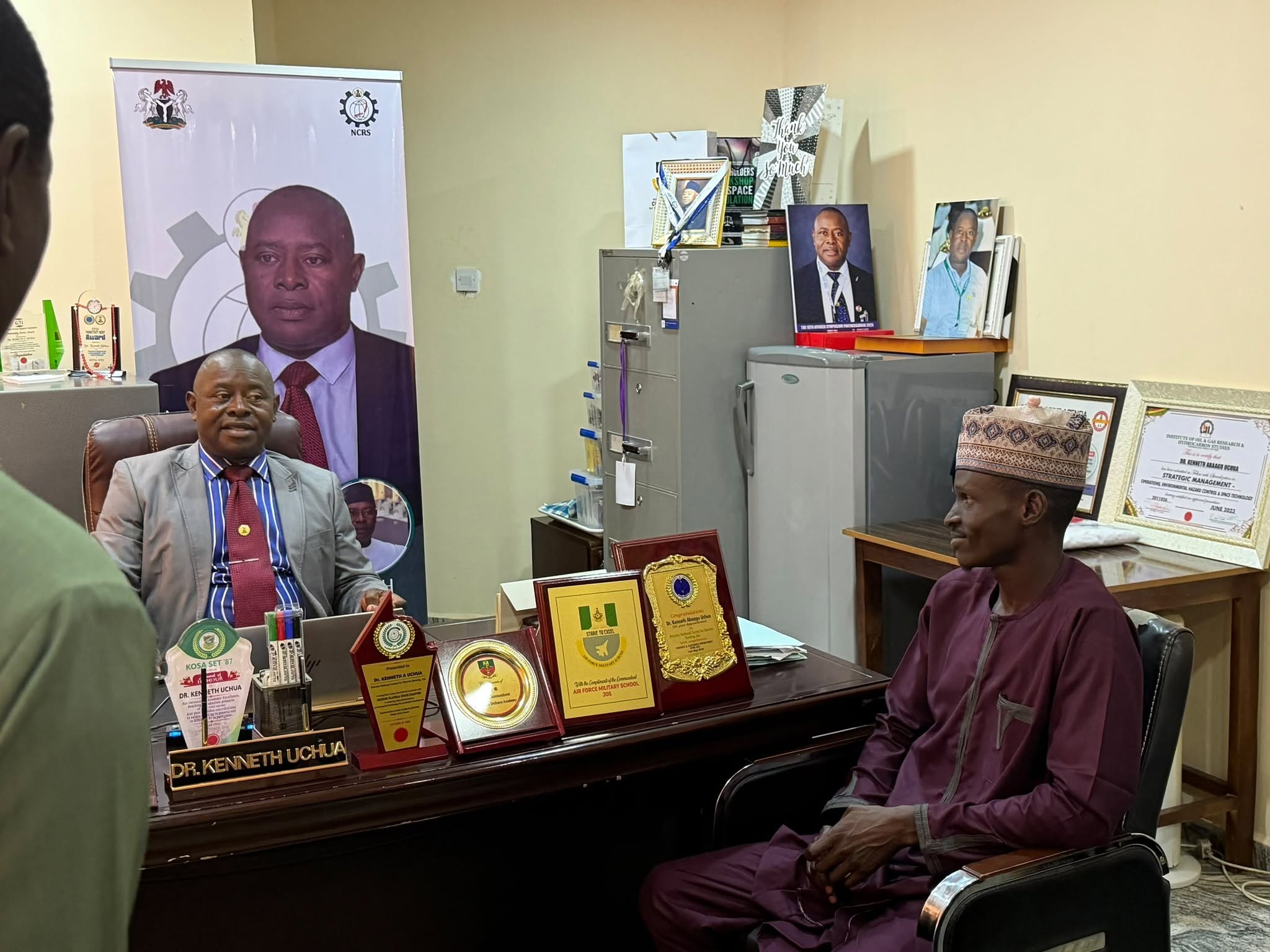
The National Centre for Remote Sensing (NCRS), Jos, has stepped up efforts to promote science and technology education among young people by hosting students and representatives of two secondary schools on an educational visit to the Centre.
The visiting schools, Premier Academy, Bukuru, and Sterling Spring Ville Academy, were received at NCRS on Monday, November 9, 2026, as part of an initiative to expose students to remote sensing technology, its applications and career opportunities in the space science sector.
The Premier Academy delegation was led by its Vice Principal, Mr Alhamin Yusuf, accompanied by Mr Abdul Nasir A. Bello and other school representatives, while Sterling Spring Ville Academy was represented by a delegation led by Mr Innocent Jonah.
Welcoming the delegations, the Director of NCRS, Dr Kenneth A. Uchua, expressed delight at the schools’ interest in science, technology and innovation. He urged school authorities to sustain efforts towards encouraging students to develop interest in science-related disciplines, especially physics, describing it as fundamental to technological advancement and the development of future innovators.
Dr Uchua, who addressed the students during a sensitisation programme at the Centre’s auditorium, introduced them to the concept of remote sensing, explaining how information about objects, features and locations can be obtained without direct physical contact.
He highlighted the technology’s capacity to save time and resources, minimise exposure to risks and provide reliable information for planning, monitoring and decision-making. He also encouraged the students to consider careers in aerospace engineering, software engineering and space science, noting the growing opportunities in science and technology.
In a technical presentation, Mr Shadrach Eneojo of the Collaboration Department explained the fundamental principles of remote sensing, the various types of sensors and their applications.
Using diagrams and illustrations, he demonstrated how satellite imagery and remotely sensed data are deployed in environmental monitoring, urban development, land-use analysis and the assessment of changes in the environment.
The programme featured an interactive question-and-answer session, during which the students sought clarification on the operations, applications and establishment of the Centre. The visiting delegations commended NCRS for the warm reception and opportunity to gain first-hand knowledge of remote sensing technology, while expressing interest in sustaining the relationship through future educational engagements.
A major highlight of the visit was a guided tour of the Centre’s Ground Receiving Station, where Mr Donald Toluwa explained its operations, demonstrated some of the equipment and highlighted the processes involved in satellite data acquisition and processing.
Also speaking during the tour, Mr Richard Tallen encouraged the students to explore credible online learning resources to broaden their knowledge of remote sensing and keep abreast of developments in space science and technology.
The visit underscores NCRS’s commitment to scientific outreach, technology awareness and human capacity development, particularly among young people, as part of efforts to stimulate early interest in science, technology and innovation and nurture the next generation of professionals in the space sector.