

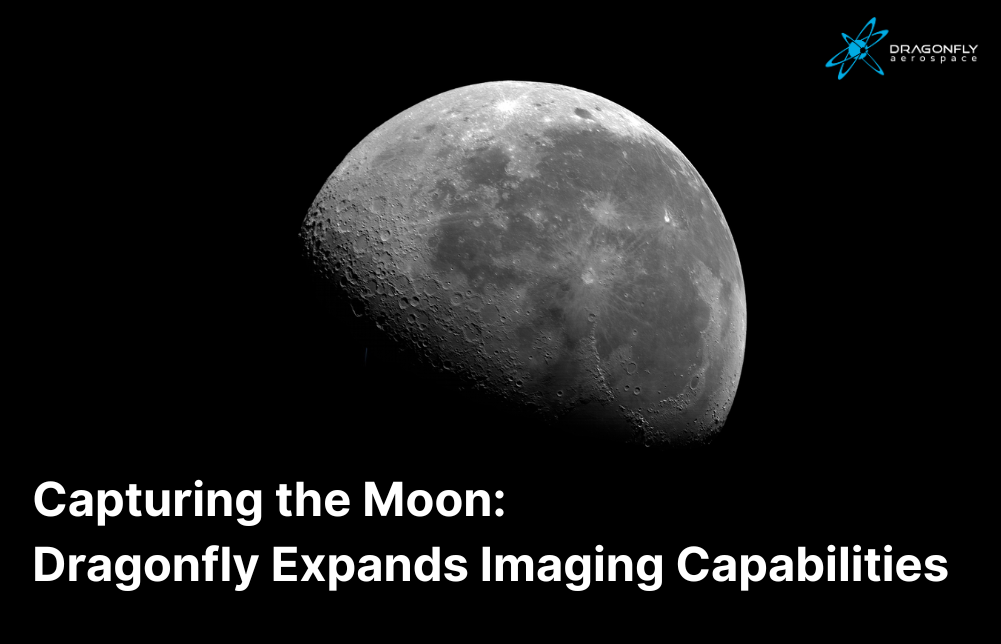
Dragonfly Aerospace has successfully demonstrated a significant new capability: capturing high-precision images of the Moon using the dual DragonEye imagers aboard its EOSSAT-1 satellite. This achievement represents a key milestone in the company’s ongoing efforts to extend its imaging technologies beyond traditional Earth observation, marking its expansion into Non-Earth Imaging.
What is Non-Earth Imaging (NEI)?
While most small satellite missions are designed for Earth observation, Non-Earth Imaging (NEI) focuses on capturing images of objects beyond our planet. This includes the Moon, other planets, asteroids, space debris, and celestial reference points.
NEI enables the validation of imaging systems in deep-space conditions. Moreover, it contributes to Space Situational Awareness (SSA), and supports future lunar and planetary missions. In many ways, NEI bridges the gap between Earth observation and deep-space exploration, expanding our ability to study and monitor the universe.
EOSSAT-1: Precision Non-Earth Imaging in Orbit
Dragonfly used EOSSAT-1’s ductile mode, a function typically reserved for tracking inertial points, to image both a full Moon and a waning Moon. Because the DragonEye payloads are linescan cameras, the satellite must perform a continuous pitch manoeuvre over the target. As a result, it constructs the image line by line, rather than capturing it in a single frame. This required EOSSAT-1 to maintain an exact and stable pitch rate, placing significant demands on its Attitude and Orbit Control System (AOCS).
Although the Moon’s apparent motion across the sky is relatively slow, the satellite must execute continuous and highly accurate pitch adjustments to compensate for its velocity and maintain precise line-of-sight alignment. EOSSAT-1 successfully captured multiple lunar phases, proving its ability to maintain stable attitude control on inertial targets. This performance exceeds what standard small satellite platforms can typically achieve.
The system transitions to an experimental Moon imaging mode in under five minutes. This rapid transition capability enables testing of new control and imaging techniques without disrupting commercial operations.
Versatile Imaging for Complex Space Missions
Dragonfly Aerospace develops platforms designed for multi-purpose imaging missions. Although the company’s core expertise lies in high-performance Earth observation, the μDragonfly bus and other satellite platforms offer engineered flexibility, making them capable of:
- Monitoring space assets and tracking debris
- Calibrating onboard sensors using inertial points
- Supporting lunar and planetary exploration
- Validating satellite stability and control systems
The recent lunar imaging demonstration highlights both the increasing importance of NEI and SSA in commercial satellite operations and the advanced capabilities built into Dragonfly’s platforms. Furthermore, this success reflects the company’s commitment to meeting emerging demands in space technology.
Why These Capabilities Matter
As the space environment becomes more congested and complex, the need for reliable Space Situational Awareness (SSA) and Space Domain Awareness (SDA) is increasing. Imaging objects beyond Earth, including the Moon, satellites, and orbital debris, plays a critical role in this effort. These capabilities support collision avoidance and traffic management, enable sensor calibration and technology validation, and contribute to mission planning for future lunar and planetary exploration.
Dragonfly Aerospace remains committed to providing flexible, high-performance satellite solutions that go beyond Earth observation. Both the μDragonfly platform and Dragonfly’s custom payloads are designed to support:
- Earth Observation (EO)
- Non-Earth Imaging (NEI)
- Space Situational Awareness (SSA)
- Scientific and exploratory missions
Looking Beyond Earth
As satellite operations evolve, capturing and processing data beyond Earth grows increasingly valuable. Not only does this advance exploration, but it also enhances space safety, security, and sustainability.
Dragonfly Aerospace’s successful demonstration with EOSSAT-1 highlights the potential of small satellite platforms to assume larger roles. Specifically, roles in space monitoring, technology validation, and Non-Earth Imaging. Together, these developments pave the way for broader applications beyond traditional Earth observation