


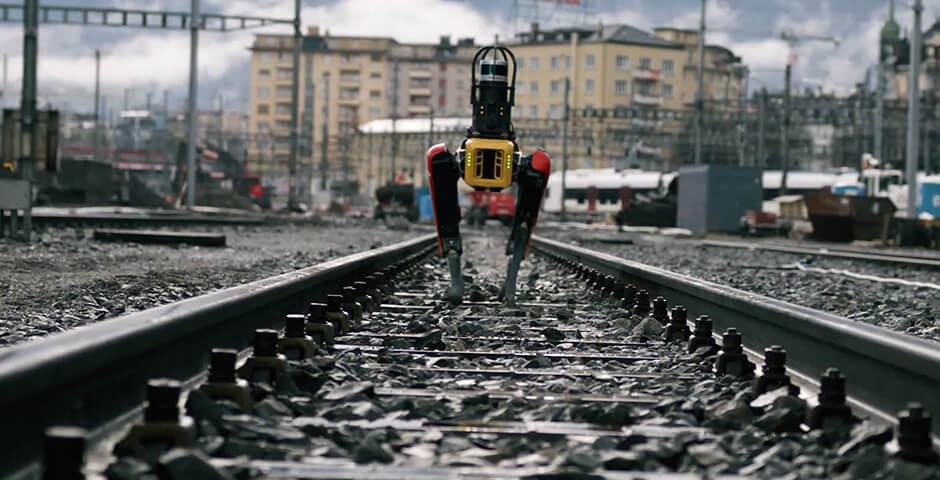
They often work at night, unnoticed by the public, yet ensuring all our safety. These are the specialists from Rhomberg Sersa, a leading company in the field of track construction and maintenance. For some time now, high technology has gone hand in hand with steel, gravel and ballast on the construction site. This both ensures the most effective use of the extremely tight maintenance windows and increases safety for workers and train passengers.
Most people know from their own experience that construction is no simple matter. We have all heard of people who take on one construction project, but decide never to repeat the endeavour. Opinions about construction workers are formed quickly, and often unfairly.
There are additional challenges when it comes to constructing railway infrastructure: extremely short time frames, night shifts, dangerous and hard physical work. In tunnels, for example, you can’t simply double the number of machines or workers; it requires meticulous planning. Digitisation could help in many cases. In the future, digital images of construction sites – digital twins – will be created, simulated and optimised before the excavators drive up with gravel and ballast and implement the model 1:1.
Combining technology with construction site reality
If digitisation projects fail, it is much more likely a result of focus or culture rather than lack of know-how. The Swiss family-owned company Rhomberg Sersa Rail Group has successfully been able to combine technology with the physical aspects of the construction site. Here, large machines, gravel, ballast and steel come together with 5G, the Internet of Things, the cloud and data-driven business. For Rhomberg Sersa, the 5G network is also key to its to future plans.
As Hubert Rhomberg, co-owner of Rhomberg Sersa, explains: “We need innovations to increase our sustainability and efficiency. The construction industry creates lots of emissions, and it is organised in a highly patchwork fashion.” Another driver for digitisation is the shortage of skilled workers demographically: “Working in construction is not sexy. We have to make the work more attractive so that we can continue to find the best personnel in the future. These days, we hire foremen alongside programmers or game developers and they work hand in hand.”
How does innovation work?
Hubert Rhomberg explains: “We need to be consistent in the way we share knowledge. Communication is key across all units and levels.” Technology is secondary: it’s about people and cooperation. If a foreman on a construction site wants a particular app because he saw a colleague use it, you have achieved your goal. You have to win people over.
When Rhomberg Sersa is on a construction site, usually at night, working to very tight deadlines, an increasing number of digital tools are supporting its construction workers. The first steps to a digital construction site, such as artificial intelligence, have been implemented in advance. It recognises the types of construction machines in pictures. Christian Schollenberger, Head of IT at Rhomberg Sersa, explains: “We gave Swisscom’s data scientists 40 hours to develop the data model. We can recognise devices and machines in photos. The model now has 95 per cent accuracy.” This information flows into planning and logistics.
Hubert Rhomberg has a practical view of innovation: “Innovation is not witchcraft; it’s a systematic approach. Collect ideas, evaluate them, park them, discard them or move on. Out of ten ideas, only two will make it further.” But not at any cost: “You have to create a precise framework and stop if you don’t reach the intended goal. You discard these ideas or accept the timing is not right,” adds Hubert Rhomberg.
Microscope on rails
Another step is the prototype of a track survey trolley on which a cloud, mobile network connection and much more is installed. Christian Schollenberger said: “The cameras on the survey trolley measure the railway track while it is moving with an accuracy of tenths of a millimetre. This allows you to see where maintenance work is needed and to reduce breakdowns on the world’s busiest rail network.” The survey trolley even detects loosened nuts when travelling at 60 km/h over the track.
Rhomberg Sersa and Swisscom are currently working on a total of five sub-projects, which include 5G, the Internet of Things, cloud and data-driven business, which they are testing in the tough track construction environment. According to Julian Dömer, Head of IoT at Swisscom: “We are testing the technologies in the tough environment and proving they work. The systematic innovation at Rhomberg Sersa serves as a model for the entire industry. They are combining technical innovation with economic benefit.”
More on innovation, technology and track construction in the roundtable discussion from IoT Day, 6 May 2021, including Hubert Rhomberg, co-owner of Rhomberg Sersa Rail Group :