

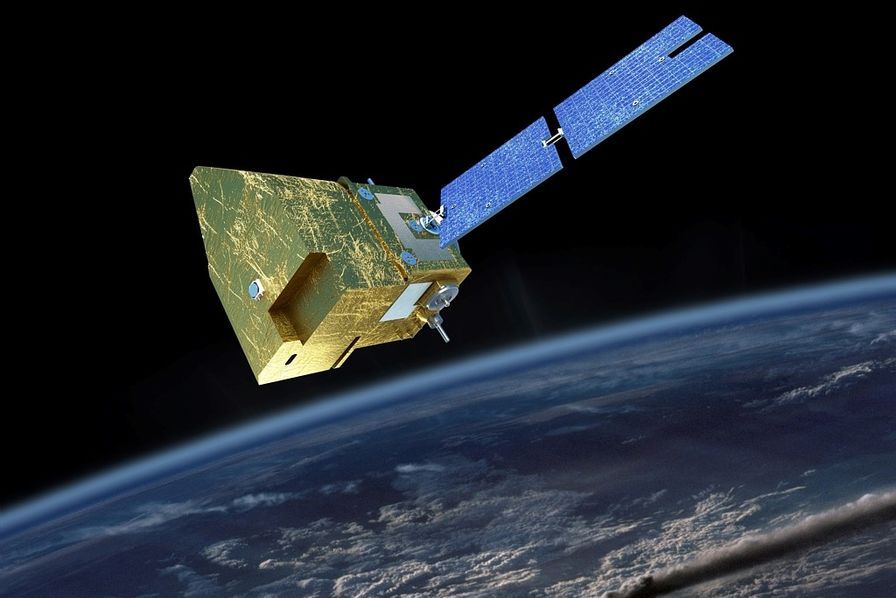
At the heart of the MicroCarb project: the notion of scientific demonstration. The Franco-European mission is a precursor program for future operational systems for measuring greenhouse gases.
Developed by CNES with funding from the French government’s Future Investment Plan (PIA), as well as with contributions from the United Kingdom Space Agency (UKSA) and the European Union, MicroCarb is a scientific mission dedicated to studying CO2 flows on the Earth’s surface.
Unlike an “operational” satellite, whose purpose is to rapidly provide stabilized and continuously delivered products for a service defined in advance, the MicroCarb mission has a “demonstrative” objective. It will deliver new scalable products that meet the needs of the scientific community.
In particular, MicroCarb will make it possible to identify the determining parameters of the measurement principle used to estimate the CO2 content of the atmospheric air column.
The mission thus has greater latitude over the schedule for calibrating and validating in-flight measurements, but also more tolerance regarding possible satellite maintenance periods and valuable flexibility for adapting data processing.
The demonstration covers three parts:
- the validation of several on-board technological innovations,
- achieving the required level of performance
- and pre-operational use of the products.
A more compact optical instrument
On the technological side, CNES engineers have achieved the feat of designing, in collaboration with Airbus Defence and Space, a more compact and lighter optical instrument allowing the satellite to reach a mass of 180 kg – up to nine times lighter than some CO2 measurement satellites such as GOSAT, from the Japanese space agency (JAXA). Since the price of a satellite is proportional to its mass, these innovations in the optical field could open up prospects in the context of a constellation.
In addition, MicroCarb benefits from a spectral band observed for the first time by a satellite and exploited thanks to innovative treatments modeling a previously unknown physical process, called “airglow “. This modeling will make it possible to better correct the disturbances induced by aerosols and thus achieve increased precision for the final measurement of CO2 contained in the atmosphere.
Optimize performance
From a performance perspective, CNES engineers are seeking to demonstrate that it is possible to do as well, or even better, than current missions.
From phase A of the mission, CNES began a huge task of characterizing the achievable performance, by implementing evaluation tools that were unmatched in the world at the time.This made it possible to define an optimal operating point for the instrument.
Didier Pradines
MicroCarb System Manager at CNES
This optimization was achieved through the choice of spectral bands and their resolution, the signal-to-noise ratio, and spatial resolution. The teams are working to improve the processing algorithms, whether from data from the OCO-2 mission, from those provided by the TCCON ground stations, or from MicroCarb measurements obtained during thermal vacuum tests or during simulations.
With an estimated data production of 80 GB per day and very complex algorithms, a processing center composed of 4,500 computing cores was deployed to maintain the rate of measurement acquisition throughout the mission.
Finally, on the pre-operational use side, the project has committed to being able to deliver to the European Copernicus service 95% of its atmospheric CO2 concentration data within 24 to 48 hours following the acquisition of measurements by the satellite. This is in order to prepare for the arrival of data from future operational CO2M satellites in Copernicus.
” With the MicroCarb scientific mission, we mainly want to show that it is possible to make a satellite that is small, inexpensive and efficient, to monitor global CO2 flows . Faced with the challenges of designing the instrument, we were fortunate to benefit from exceptional French know-how that led to great innovations. We are now ready to fly this technological gem to demonstrate its capabilities in flight, ” added Didier Pradines.