


Most of the world is likely to suffer from light pollution, which will threaten the continued use of observatories
Our night sky is changing. A new study published in the Monthly Notices of the Royal Astronomical Society has found that within a few years satellites will brighten the Earth’s sky by 10% compared to natural visibility conditions. Unlike artificial light sources on the ground, like street lighting that illuminates limited and specific areas, satellites, which reflect sunlight at certain hours, illuminate the vast majority of the planet. This means that even if astronomers – professional and amateur – try to observe bodies far from “light reserves” with zero light pollution, such as Ramon Crater for example, visibility will still be significantly impaired.
Global light pollution
The continued launch of mega-arrays of satellites such as Starlink and OneWeb, which aim to provide Internet from space to any point on Earth, is already creating problems with astronomical observations, especially when it comes to long-distance photography of distant and dim bodies such as galaxies and star clusters . Will pass between the telescope on the ground and the object in the sky.
But so far the possibility has not been examined that the light reflection of each and every satellite contributes to global light pollution, even if it does not pass between the telescope and the object. Now, for the first time, an international team of researchers from Slovakia, Spain and the US has created a computerized model of different satellites – active and inactive – and the level of light reflection of each of the types of satellites orbiting the world.
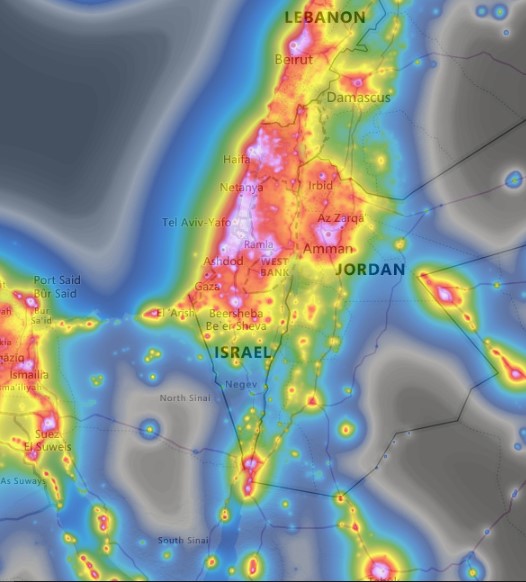
According to the researchers, the sunlight reflected from each satellite is negligible, but the multiplicity of satellites is increasingly clarifying the night sky. Continuing to launch the satellite arrays, the researchers warn, will clear the sky itself by more than 10% and hurt basic astronomical research around the world. It should be noted that a 10% brightness is the definition for a “light-polluted” region, so that if the gloomy prediction comes true – most of the planet will suddenly become polluted. Even in the most uninhabited and remote areas there will be no good visibility of the Milky Way or observing meteor showers but from the polar regions.
Tens of thousands of new satellites by the end of the decade
Today, about 6,000 satellites orbit the earth, about half of which are active. These are all the military, civilian and scientific satellites, of all countries and all societies. But in the coming years this number is expected to skyrocket with the launch of mega-arrays of satellites. In Space X has already launched satellites Starlink 1200, making an increase in satellite Starlink. And this is just the beginning: in order to provide high-speed Internet services to any point on Earth, SpaceX intends to launch 42,000 Starlink satellites by the end of the decade. OneWeb plans to launch 650 satellites in the first phase – and an additional 6,372 satellites in the coming years. Amazon has also recently entered the race, and has already applied to the FCC for a license to launch 3,236 communications satellites as part of the Quipper Project.
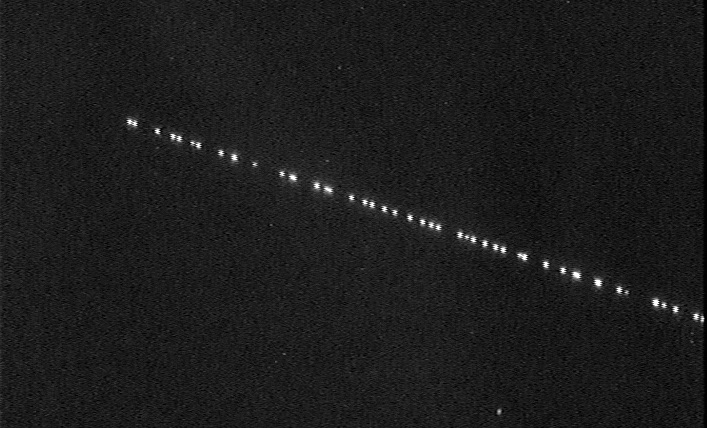
The U.S. National Science Foundation, as well as the United Nations Office for Outer Space Affairs, recently announced that satellite mega-arrays pose a real threat to the continued use of observatories on Earth. In January of this year, SpaceX changed the structure of the Starlink satellites so that they would be only 31% brighter than the original Starlink satellites, but it seems that the cumulative effect of multiple satellites is likely to jeopardize observational astronomy from Earth – and spoil our night sky viewing experience.
Source: Israel Space Agency